
Home / Detailing Tools / Car Detailing Tools & Equipment Guide
COMPLETE GUIDE
Car Detailing Tools & Equipment Guide
An informational map of car detailing tools and car detailing equipment by job — wash, dry, interior, decontamination, correction, protection — not a ranked kit list, price sheet, or shop directory.
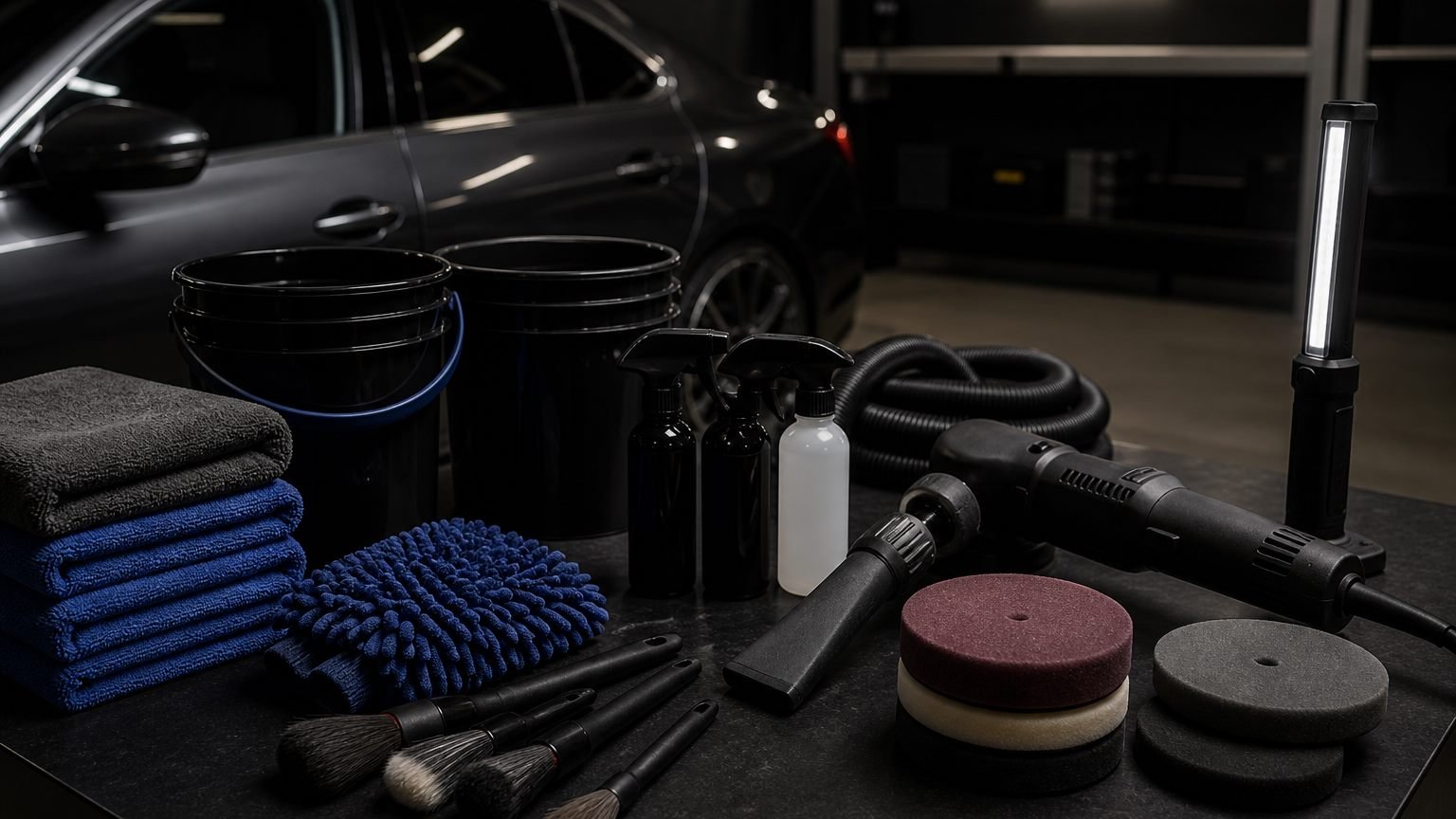
This image is an editorial illustration of organized, unbranded detailing tools on a workbench. It is not original process photography and it is not evidence that ProTaskser owns, tested, or sold the items shown.
If you searched car detailing tools or car detailing equipment, you usually want a map: what belongs in a driveway kit, what waits until the job actually needs it, and what is marketing dressed up as a shopping list. This page is that map. Dedicated kit and brush guides are available, and a microfiber towel guide covers multi-task detailing towels. Where a dedicated guide is not linked, this page stays at category level.
Car detailing tools are job-specific. A wash mitt is for lubricated contact on paint. A wheel brush is not. A dual-action polisher is for controlled abrasion after the paint is clean, not for a first wash. Chemical Guys’ Car Detailing Equipment List (dated 15 June 2025, checked 24 August 2026) splits the world the same way: a starter wash kit first, then brushes and applicators, then optional upgrades such as a dual-action polisher, foam cannon, and clay. That split is useful. It is not a ranking.
Process still beats hardware. If you need the wash method itself, use the how to wash a car properly guide. If you need the whole detailing order, start at the complete car detailing guide. This page answers which classes of car detailing equipment support those jobs, and when buying more gear is optional.
In this guide
- What is necessary vs optional
- Beginner starter setup
- Wash tools
- Drying tools
- Interior tools
- Vacuums, extractors, and steam
- Decontamination and correction tools
- Protection and application tools
- Lighting and inspection
- Power tools vs manual methods
- PPE, safety, care, and storage
- How to choose tools
- Common buying mistakes
- Beginner checklist
- FAQ
What car detailing tools are actually necessary
Necessary means: you cannot do the job safely or repeatably without it, or the substitute is worse than the job. Optional means: it can save time, add capacity, or raise a ceiling you do not have yet. Most “must-have 40-piece kits” mix those two piles.
For a typical owner who wants to wash and dry a car without grinding grit into clear coat, the necessary pile is small. Chemical Guys’ equipment list treats two buckets, a dedicated wash mitt or pad, microfiber towels, a grit-guard style insert, and a pH-balanced car-wash soap as the basic toolkit. That is a wash-first list, not a full detail. You still need a hose you can control, a separate tool for wheels, and a way to dry. You do not need a pressure washer. Chemical Guys’ own FAQ on that page (checked the same day) says a pressure washer is not required; a garden hose and technique can rinse. Treat that as a category statement, not a product review.
Optional, at this guide’s level: foam cannons, pressure washers, dual-action polishers, clay, extractors, steamers, filtered air dryers, and inspection lights. Each solves a narrower problem. Buying them before you can wash and dry without scratching is how garages fill with unused motors.
A “detailing kit in a bag” is a packaging choice. Judge it by the jobs inside it, not by piece count. Dedicated kit comparisons belong later.
Beginner starter setup and staged upgrades
Stage the spend to the sequence, not to a catalog photo.
Stage 1 — wash and dry without making the paint worse. Two buckets or a real rinse habit, a paint mitt, a separate wheel tool, labeled car-wash soap, grit control in the rinse water, plush drying towels, and shade when you can get it. That is enough to support the wash guide. If the car is only dusty, you still wash with lubrication rather than a dry towel.
Stage 2 — interior and glass that you can actually finish. A vacuum you already own may be enough for crumbs. Dedicated interior brushes, a crevice tool, and glass towels that you do not use on wheels come next. Steam and extractors wait until fabric soil actually needs them.
Stage 3 — bonded contamination after a correct wash. If the paint still feels rough after a rinse, that is not a reason to buy a polisher. It is a reason to read the paint decontamination guide and to treat clay, iron chemistry, and tar removers as later, labeled steps — not as wash-mitt jobs.
Stage 4 — correction only when defects are in the clear coat. Swirls that survive a clean, decontaminated panel are a polishing problem. That is the paint correction guide, not a shopping cart. A dual-action polisher is optional equipment for that job. It is not required to “detail” a car, and it is not safe to treat as a toy because a marketing FAQ called orbitals beginner-friendly.
Stage 5 — protection as a separate decision. Applicators and clean towels for wax, sealant, or a spray coating are cheap compared with the chemistry. Do not buy a coating because you bought a polisher.
Workspace and vehicle change the order. An apartment with a hose ban cannot stage a driveway pressure washer. A truck needs more towel area than a coupe. Budget is a constraint: buy the next tool that removes a real bottleneck, not the one with the most YouTube minutes.
Washing and contact-wash tools
Wash tools exist to keep grit in the water, not on the panel. The wash guide covers sequence: cool panels, wheels with separate tools, pre-rinse, labeled soap, panel-by-panel contact, rinse, dry. This section only names the equipment classes that support that sequence.
Buckets and grit control. Two buckets (soap and rinse) are the teaching method Chemical Guys, and most modern two-bucket explainers, still use. A grit-guard style insert is a cheap way to keep debris at the bottom of the rinse bucket. One bucket plus a hose-rinse of the mitt is a fallback, not the preferred pattern. This page will not invent a universal bucket volume.
Mitts and pads. A high-pile wash mitt or similar pad holds soil in the fibers. Kitchen sponges and bath towels do not. Keep a dirtier tool for lower body if you own two mitts — optional, not required. Never put the wheel tool back on paint.
Soap. Dedicated car-wash soap is the conservative default on a waxed or coated car. Dilution comes from the bottle you opened, not from a blog ounces-per-gallon law. Dish soap is a household degreaser, not a detailing shampoo; manufacturer wash how-tos (including Chemical Guys on the equipment list, checked 24 August 2026) treat it as a poor substitute. Follow your owner’s manual if it conflicts, and still read the label.
Wheel tools. A dedicated brush or mitt for barrels and faces. Chemistry for wheels is labeled and finish-specific. Polished aluminum, colored coats, and chrome do not share one acid. This guide will not publish a fake dwell time.
Foam tools and pressure washers. A foam cannon or foam gun can hold lubricant on the car. It does not replace contact washing on a dirty vehicle. A pressure washer can speed rinse and pre-wash. It is optional. Close range on seals, badges, and sensors is how convenience becomes damage. Technique and nozzle distance belong to a later pressure-washer article, not a universal PSI number invented here.
Drying tools
Drying is part of the wash. Leaving a wet car in sun is how minerals become spots, especially on dark paint. The equipment question is how you get standing water off without turning the towel into sandpaper.
Towels. Plush drying microfiber is the default driveway tool. Use more than one on a large SUV. If the towel grabs, switch. Color-code so a wheel towel never dries glass. Dedicated towel comparisons belong later. Here: clean, dedicated, not a bath sheet.
Air. Filtered blowers and “car dryers” reduce towel contact. They can also blow grit off a dirty floor onto wet paint. They are optional, not a requirement for a proper hand wash. Hard water spots faster than any dryer brand can hide. Deionized rinse systems exist; they are optional equipment, not proof you washed correctly.
Interior cleaning tools
Interior tools fail when they migrate soil: a stiff carpet brush on a delicate screen, a dressing applicator on glass, a wheel brush on Alcantara. Separate the kit by surface.
Brushes. Soft brushes for vents, stitches, and buttons. Stiffer brushes for carpets and floor mats that can take it. Natural-bristle or flagged synthetic brushes are often sold for emblems and screens; the rule is still the label and a test on a hidden area. Drill-attached carpet brushes exist. They add speed and they add a way to chew fabric if you pick the wrong stiffness. Overview only: for product selection by softness, size, and task, see Best Detailing Brushes.
Applicators and towels. Dedicated interior towels. A separate glass cloth. Foam or microfiber applicators for dressings so you are not smearing product with a dirty wash mitt. Interior dressings have their own surface limits — matte plastic is not piano-black trim.
What you probably do not need on day one. A steamer, a heated extractor, and a full “interior kit” of 20 brushes. Start with vacuum access, two or three honest brushes, and towels you will actually wash. Pet hair, sand, and winter salt change the picture; they still do not require every motor in the catalog.
Vacuums, extractors, and steam — category view
These three get searched as if they were one machine. They are not.
Vacuums remove loose soil. A household vacuum with a dusting brush and crevice tool can empty a cabin. Shop vacs add capacity. Do not invent a “best CFM for cars” number here.
car detailing extractors push solution into fabric and pull it back. They are for soiled carpets and cloth seats, not for a dusty dash. Over-wetting foam, electronics, and leather is the failure mode. Follow the machine manual and the chemical label.
Steam is hot water vapor on surfaces the steamer maker allows. It is a scald and electronics hazard if you ignore the manual. This page will not publish a universal temperature. If you buy a steamer, the nameplate and the vehicle’s interior materials win. None of these machines replace an exterior wash or paint decontamination.
Decontamination and correction tools
After a correct wash, paint may still feel rough. That roughness is often bonded contamination — industrial fallout, embedded grit, sap that survived labeled washing — not proof you need a polisher. Mechanical clay (bar, mitt, or synthetic pad) plus a dedicated lubricant is one class of tool. Chemical decontamination (iron removers, tar solvents) is another. Both have surface limits. Both belong after a wash, not instead of one. The paint decontamination guide is the process page. This guide only places the tools in the map: clay is not a wash mitt, and a polisher is not clay.
Correction tools remove a thin layer of clear coat to level defects. Dual-action (orbital) polishers, rotary polishers, backing plates, and foam or microfiber pads are that family. Pads are not generic sponges. A cutting pad and a finishing pad are different jobs. Speed charts, pad size, and orbit diameter belong to that machine’s manual. Griot’s Garage G8 Mini Random Orbital Polisher instructions (PDF 10908, checked 24 August 2026) publish speeds for that model and warn you to use the pad system the tool was designed for. Copying that model’s 2,000–6,400 OPM range onto every polisher would be a fake spec. Meguiar’s G110/G220-class dual-action manuals (checked the same day via the published instruction set) tell the operator not to run the machine with the pad off the vehicle, and to start and stop with the pad on the work surface. Follow the nameplate voltage and the accessory RPM/OPM rating. Do not treat a dual-action polisher as incapable of damage because a retailer FAQ called it beginner-safe.
If you do not have defects you are willing to remove clear coat to fix, you do not need this class of car detailing equipment yet. Correction is never a wash, and it is never decontamination.
Protection and application tools
Protection chemistry — wax, sealant, spray coating — needs clean, decontaminated paint and a way to spread a thin, even film. The tools are usually applicators and towels, not motors.
Foam or microfiber applicator pads hold product and reduce finger pressure marks. Dedicated interior and exterior applicators stop you from using a dressing sponge on glass. Some people apply with a dual-action machine on a finishing pad at the speed that manual allows for protection products. That is optional technique, not a requirement, and it is easy to overwork a coating if you ignore the label.
This page will not install a ceramic coating, quote a warranty year, or pick a brand. Application tools do not create protection. The product chemistry and the prep do. If you came here because you want the wider detailing order, return to the complete car detailing guide for sequence, then buy applicators that match the product you actually opened.
Lighting and inspection tools
You cannot correct what you cannot see. Sunlight and a consistent inspection light are how swirls, holograms, and leftover compound show up. Griot’s G8 instructions tell the operator to evaluate defects with sun reflection or a dedicated swirl-finder light before choosing pad and polish aggressiveness. That is inspection, not a shopping ranking.
Useful traits, without fake lux numbers: a daylight-balanced lamp you can hold at a low angle, and enough brightness to see holograms after a machine pass if you ever take that path. Phone flashlights lie. A dedicated detailing light is optional until you are making correction decisions. For a wash-only owner, daylight after drying is enough.
Power tools versus when manual methods are enough
Power is capacity. It is not quality. A dual-action polisher covers panels faster than an applicator pad. A pressure washer rinses faster than a hose. An extractor pulls liquid faster than towels. Each one also adds a failure mode: heat, water intrusion, over-wet foam, thrown pad, extension-cord voltage drop.
Manual is enough when the soil is loose, the panel is small, or you have not yet earned the next risk. You can wash a car properly with a hose. You can dry with towels. You can clean a dash with brushes. You can apply wax by hand. You should not clay a dirty car, and you should not polish contamination into the clear coat, power or not.
Buy a motor when you have a repeating job that is limited by time or by a tool you already use correctly by hand. Do not buy a motor to skip learning the job. Manufacturer polisher manuals still assume you already washed, assessed contamination, and chose the least-invasive method — Griot’s G8 PDF states that order explicitly for that tool. A machine does not replace that order.
PPE, electrical safety, care, and storage
Chemicals and spinning pads are not decorative. Read the SDS and the tool manual for the product in your hand. This page will not invent a universal glove material, respirator cartridge, or dilution.
Eyes and lungs. Griot’s G8 polisher instructions require eye protection that conforms to ANSI Z87.1 for users and bystanders, and they warn that polishing can generate dust; they point operators to NIOSH/OSHA-appropriate respiratory protection and to the polish manufacturer’s SDS. Meguiar’s G110/G220-class manuals likewise require safety glasses (ANSI Z87.1). Those rules attach to those tools. A wash with labeled soap still deserves splash awareness. A steamer still deserves scald awareness.
Power tools. Prevent unintentional starting. Unplug before changing pads. Use an extension cord with adequate gauge for the nameplate current and the cord length in that manual’s table. Keep vents clear. Start and stop dual-action machines with the pad on the panel when the manufacturer says to. Accessories must be rated for at least the tool’s maximum speed — Griot’s G8 manual states that rule for that polisher.
Pressure and heat. Follow the washer’s allowed soap inlet, nozzle pattern, and the distance the maker specifies. No invented PSI-at-paint figure in this guide.
Care and storage. Rinse mitts and towels. Wash microfiber as the towel maker instructs; fabric softener is commonly discouraged because it can leave residue — if your brand says otherwise, the brand wins. Keep wheel tools away from paint tools. Replace towels and mitts when they are crunchy, torn, or permanently soiled. Store chemicals upright, capped, away from kids and pets, at the temperature range on the label.
How to choose tools by task, vehicle, workspace, and budget
Choose backwards from the job.
Task. Wash, dry, vacuum, decontaminate, correct, protect. Buy the class that matches the next job you will actually finish. A polisher does not help a dirty wash mitt.
Vehicle. Soft-top, matte wrap, polished wheels, and piano-black trim all reject generic kits. Owner’s manual and film/coating maker beat a bundle SKU. Larger vehicles need more towel area and more rinse water, not necessarily a bigger motor.
Workspace. Hose access, drainage rules, electrical outlets, HOA noise, and indoor vs outdoor storage matter more than a “pro kit” photo. If you cannot use a pressure washer legally or safely, it is not a gap in your character. It is a workspace constraint.
Budget. Spend on consumables you will replace — soap, clean towels, a mitt — before ornamental machines. There is no honest “best under $X” table on this page because this site has not tested products and will not scrape fake prices. A cheaper dual-action from an unknown maker is not automatically safer. Check the manual, the pad system, and whether you can get parts.
If two tools claim the same job, prefer the one whose manual you will read and whose consumables you can buy again. That is selection logic, not a ranking.
Common buying mistakes
Starting with a polisher. Correction on dirty or contaminated paint is how you mill grit into clear coat. Wash and decontaminate first. Process pages already exist for those jobs.
One sponge for everything. Wheels, paint, glass, and interior are different soils. Cross-contamination is a technique error that no brand of “kit” fixes.
Dish soap and bath towels as the default kit. Convenient, and the opposite of what car-care wash how-tos recommend for protected paint.
Piece-count kits. Forty pieces can still omit a second bucket and include a rotary nobody should hand a first-timer. Count jobs, not SKUs.
Pressure-washer bravado. Optional rinse tool, not a personality. Distance, seals, and labeled soap inlets matter.
Treating marketing FAQs as physics. Manufacturer polisher manuals talk about eye protection, pad-on-surface starts, accessory speed ratings, and SDS — not “almost impossible to go wrong.”
Buying lights, steamers, and extractors to avoid learning a wash. The wash guide is cheaper than a garage full of unused motors.
Practical beginner checklist
Use this as a job list, not a store list. Skip any line your workspace or vehicle cannot support.
- Hose with a controllable nozzle, or another legal rinse source.
- Two buckets, or one bucket plus a real mitt-rinse habit.
- Grit-guard style insert if you can; not mandatory, useful.
- Paint wash mitt or pad. Separate wheel brush or wheel mitt.
- Labeled car-wash soap. Read dilution. No invented recipe.
- Clean drying towels dedicated to paint. Extra towels for a large vehicle.
- Interior: vacuum access, one soft brush, one carpet-safe brush if needed, glass towel.
- PPE that matches the chemicals and tools you actually use: at minimum, respect splash and, for spinning pads, the eye protection the polisher manual names.
- A place to wash that is legal for you, preferably shade, on a surface that is not loose gravel.
- A way to wash the wash tools so they are not grit sponges next time.
Add clay, iron remover, a dual-action polisher, foam equipment, extractors, and steam only when the job in front of you needs that class — and only after you have a process page or a manufacturer label for that step.
FAQ
What car detailing tools do I need to start?
Start with wash and dry: two buckets or an equivalent rinse habit, a paint mitt, a separate wheel tool, labeled car-wash soap, and clean drying towels. Chemical Guys’ equipment list (15 June 2025, checked 24 August 2026) puts buckets, mitt, microfiber, grit control, and pH-balanced soap in the basic toolkit. Interior vacuuming can use a household vacuum. Polishers, foam cannons, and steamers are upgrades, not the definition of detailing.
Is car detailing equipment the same as car detailing tools?
Yes. “Tools” often means hand items (mitts, brushes, towels). “Equipment” often means machines (vacuums, polishers, washers). People use them interchangeably, so this guide covers both.
Do I need a pressure washer to detail a car?
No. Chemical Guys’ equipment FAQ states a pressure washer is not required and that a garden hose plus technique can rinse. A pressure washer is an optional rinse and foam-cannon platform. For machine selection, see choosing a pressure washer. It does not replace contact washing on a dirty car, and it adds a way to force water into seals if you work too close.
Are dual-action polishers safe for beginners?
They are generally more forgiving than an old-school rotary, which is why retailers market them to first-time machine users. That is not the same as harmless. Meguiar’s G110/G220-class instructions say not to run the polisher with the pad off the vehicle and to start and stop on the work surface. Griot’s G8 Mini manual requires ANSI Z87.1 eye protection, warns about snagged pads, and tells you to follow that model’s speed chart and pad system. Read the manual that shipped with your machine. Do not polish dirty or contaminated paint.
Can I use household towels and dish soap?
Household bath towels and kitchen sponges are grit magnets. Dedicated car-wash soap is the conservative default if you want to keep wax or a coating. Some older owner’s manuals mention dishwashing liquid; follow your year-specific manual and the label on the bottle you open. This page will not publish a dish-soap dilution.
When should I buy a vacuum, extractor, or steamer?
When the cabin soil matches the machine. Vacuum for loose debris. Extractor for wet fabric soil you are prepared to dry correctly. Steam only on surfaces and with accessories the steamer maker allows, with scald and electronics in mind. None of them replace an exterior wash, and none of them are required for a first driveway detail.
Continue in Tools & Equipment
You now have the map: necessary wash-and-dry tools first, then interior, then contamination and correction equipment only when the job is real, with lighting, power, PPE, and storage as constraints — not as a ranked store. For ready-made bundle selection, see Best Car Detailing Kits. The detailing-brush buying guide is now live (see the Brushes section above). The detailing towels guide also covers multi-task microfiber selection. Return to the hub for the dedicated machine guides.