
Home / Car Washing / How to Wash a Car Properly
COMPLETE GUIDE
How to Wash a Car Properly
A DIY hand-wash sequence that keeps grit off paint — not a local car-wash directory, automatic-tunnel review, or product ranking. It covers how to wash a car by hand, as an owner technique.
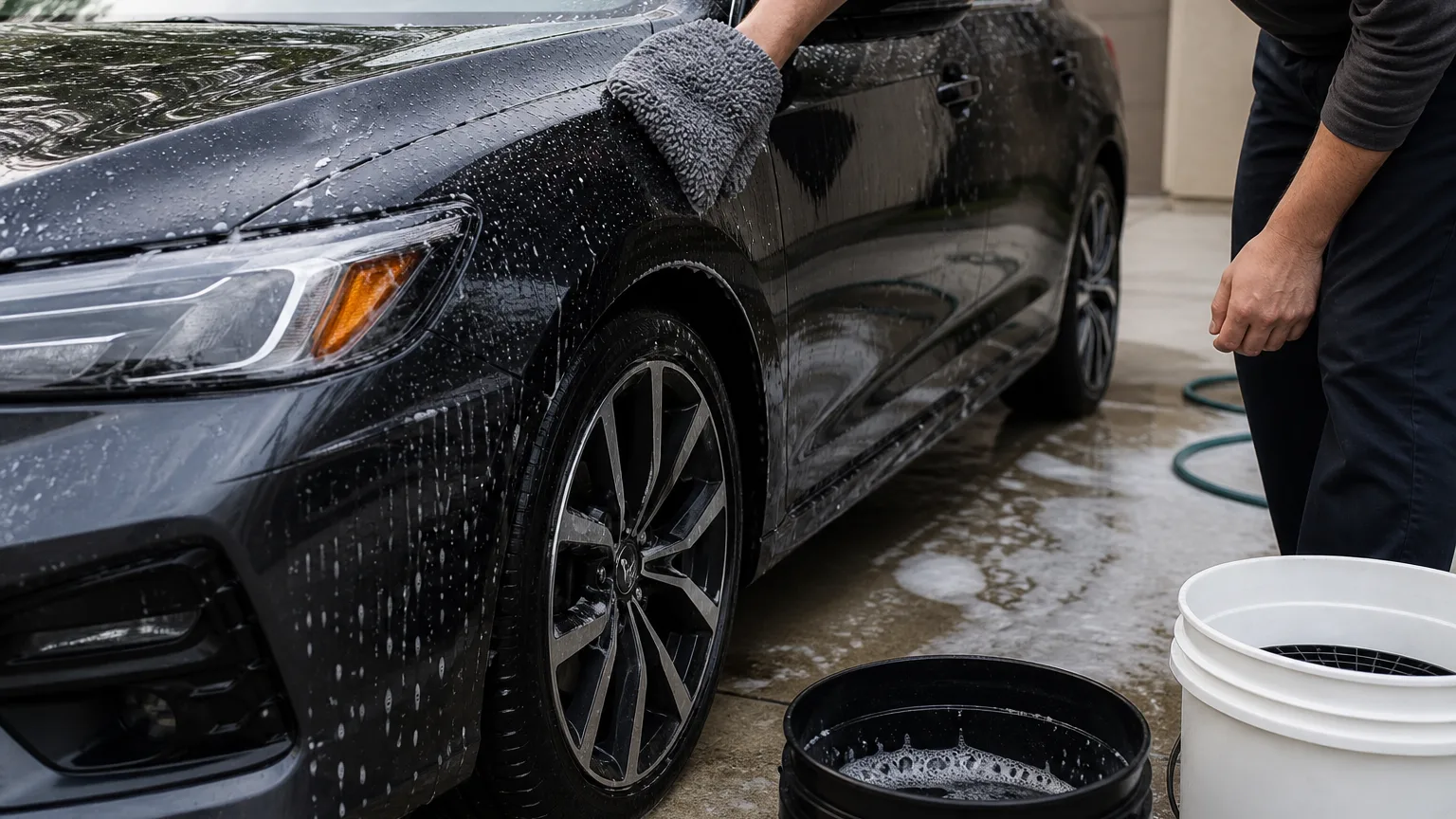
This image is an editorial illustration of a careful driveway hand wash. It is not original process photography and it is not evidence of a ProTaskser wash test.
A proper car wash is a sequence, not a product list. The job is to lift loose dirt and road film with lubrication, then get the car dry before minerals in the water mark the paint. If you searched how to wash a car or hand car wash, you are in the right place: this page is the owner-technique answer. If you searched car wash because you need a bay around the corner, maps and local listings will usually answer that faster. ProTaskser is not a wash location.
The rest of this guide is the hand-wash method you can repeat at home. Work on a cool surface, in shade when you can, pre-rinse, keep dirty tools off clean paint, and read the label on whatever soap or wheel cleaner you actually bought. Later Car Washing articles go deeper on two-bucket setups, foam tools, pressure washers, wash frequency, drying towels, and waterless methods. After you understand the wash sequence, compare car wash kits if you want a bundled starter setup rather than buying each wash item separately.
What a proper car wash is trying to do
Paint is harder than dirt, but dirt is abrasive. A wash mitt that is already loaded with grit becomes sandpaper. The point of a careful hand car wash is not to scrub until the panel looks wet and shiny. It is to keep as much of that grit in the rinse water — and off the clear coat — as you can.
Chemical Guys’ wash how-to (checked 23 August 2026) puts wheels before body contact, uses a pre-rinse, and treats two buckets as the contact-wash habit: soap in one, clean water in the other, mitt rinsed between panels. Meguiar’s Gold Class technical bulletin (checked the same day) is more product-specific, but the process cues match: rinse first, mix that product at its labeled dilution, wash a cool car in the shade, rinse from the top down, dry before spots form. Griot’s Garage’s wash how-to (checked the same day) repeats shade, pre-rinse, labeled dilution, top-down washing, and a second bucket or equivalent rinse reservoir so the mitt is not dunked back into dirty soap.
None of those sources, and this page, can promise a scratch-free result. Two buckets and a clean mitt reduce the chance that you drag the same grit around the car. They do not make scratching impossible. If someone sells you a guaranteed swirl-free wash, treat that as marketing, not physics.
The phrase car wash covers a lot: local businesses and automatic tunnels as well as how-tos. This guide focuses on the DIY washing process, not a city directory, a tunnel comparison, or a commercial wash-business pitch. Hand car wash, here, means you (or a detailer) washing with mitts and buckets — not “the hand-wash place on the ring road.”
Prep before water touches paint
Start with the car, the weather, and the ground — not the soap bottle.
Shade and temperature. Meguiar’s Gold Class bulletin says to wash in the shade on a cool surface. Griot’s says the same: out of direct sun. An older Honda owner-manual Exterior Care PDF (checked 23 August 2026) also tells owners to wash in a shady area and to let a sun-baked body cool first. Hot paint and drying wind make soap and rinse water evaporate into spots before you can move. If the only space you have is sunny, work smaller sections and do not let product dry on the panel. Do not invent a universal “safe temperature.” Cool to the touch is the practical test.
Where you wash. A driveway, a dedicated wash pad, or a site that is legal for you to use. Runoff rules are local. This page will not invent a national water-discharge number. If your city, HOA, or landlord restricts driveway washing, follow that rule. Do not wash over loose gravel if you can help it — grit on the ground finds mitts and shoes.
What to stage. A hose you can control, two buckets if you have them, a grit guard or similar insert if you have one, a wash mitt that is actually for paint (not a kitchen sponge), a separate brush or mitt for wheels, labeled car-wash soap, and clean drying towels. You do not need a foam cannon, a pressure washer, or a full kit to wash a car properly. When a full hose wash is not practical, see our Waterless vs Rinseless Car Wash guide for low-water alternatives. If you already own optional tools, they are helpers—not the definition of a correct wash.
Read the labels you will use. Dilution, dwell, surface limits, and PPE come from the bottle and SDS — not from a blog recipe. If a wheel cleaner says “not for polished aluminum,” that line wins. If a shampoo says not to use it in the sun, that line wins. This guide will not publish a fake universal ounces-per-gallon that pretends every brand is Meguiar’s Gold Class.
Wheels and the dirtiest parts first
Brake dust and road film on wheels are among the most abrasive soils on the car. Chemical Guys’ wash sequence puts wheels first for that reason: you do not want that dirt migrating onto panels you just cleaned. Griot’s wash how-to also treats wheels and lower body as dirtier work than the roof and glass.
Keep it high level here. Dedicated wheel chemistry, inner-barrel brushes, and iron removers belong with dedicated kit and wheel articles, not on this page. For a proper everyday wash:
- Use a separate brush or mitt for wheels and tires. Do not put that tool back on paint.
- Rinse the wheel well and barrel so loose grit is not waiting for your body mitt.
- Follow the wheel-cleaner label if you use one. Many acids and iron removers have surface limits. If you are unsure, rinse and a dedicated wheel soap may be enough for a maintenance wash.
- Lower rocker panels and behind wheels are dirty too. You can rinse them now. Save aggressive agitation on those panels for last during the body wash, when the rest of the car is already clean.
If a wheel is already damaged, coated, or a finish your owner’s manual treats as special, stop guessing. The vehicle manual and the coating maker beat a generic internet wheel-wash.
When you need dedicated wheel chemistry rather than regular wash shampoo, compare wheel cleaners before choosing a formula for the wheel finish.
Pre-rinse
Before a mitt touches paint, rinse the whole car. Chemical Guys, Meguiar’s Gold Class bulletin, and Griot’s all treat this as the first body step: knock off loose dust, pollen, and grit so the contact wash is not grinding dry soil into clear coat.
Work from the roof down. Open the rinse on panel gaps, around badges, and along the lower body where mud packs. You do not need a pressure washer for a proper pre-rinse. A garden hose with a controllable nozzle is enough for most driveway washes. If you do use a pressure washer, keep it as a rinse tool, not a paint-stripping tool: stay at a sensible distance, avoid forcing water into seals and electronics, and follow the washer and soap labels. See our Pressure Washer Car Wash Guide for safe setup, nozzle choice, and sequence—not a buying guide.
Foam or pre-soak is optional. A foam cannon or foam gun can hold lubricant on the car while you work. For how those tools differ in setup and workflow, see our Foam Cannon vs Foam Gun comparison — informational only, not product rankings. It does not replace a contact wash on a dirty vehicle, and it is not required to wash a car properly. If foam is drying in the sun, you waited too long — rinse and move. Do not copy a dwell time from a stranger’s video. The product label is the dwell instruction.
Wash solution and mitt
Use a car-wash soap meant for automotive paint. Meguiar’s car-care tips PDF (checked 23 August 2026) is blunt: dishwashing liquid and household detergents are not the stand-in. They can strip wax and dry out rubber and plastic. Chemical Guys’ wash article says the same: dish soap is not a substitute for dedicated car-wash soap.
That is the current car-care manufacturer position. It is not the only sentence ever printed. An older Honda owner-manual Exterior Care PDF still lists dishwashing liquid or a product made for car washing. Manuals vary by year and brand. The honest rule on this page is: follow your owner’s manual and the product you actually opened. If you still have wax or a coating you want to keep, dedicated pH-balanced car shampoo is the conservative choice. Do not treat a 1990s OEM line as a license to ignore a modern soap label.
Mix the soap in the wash bucket at the ratio on that bottle. Meguiar’s Gold Class bulletin uses one ounce per gallon for that product. Other brands differ. Copying one ounce as a universal law would be a fake spec. Fill the second bucket with clean water only.
If you want the Chemical Guys and Meguiar’s wash lines compared directly, compare Chemical Guys and Meguiar’s wash products.
The mitt should be a wash mitt or similar high-pile microfiber made to hold dirt in the fibers. Meguiar’s tips warn against T-shirts, old sponges, and similar household cloths as swirl factories. Griot’s wash how-to prefers dedicated mitts or pads and suggests keeping a dirtier mitt for the lower body if you have two. That is optional. One clean mitt, rinsed often, is enough to start.
A longer soap comparison — pH, wax-safe claims, foam vs. low-foam — has its own article. This page only needs enough chemistry literacy to keep you off dish soap by default and on the label you bought.
Panel-by-panel contact wash
This is the core of how to wash a car by hand. Load the mitt from the soap bucket. Wash one panel. Rinse the mitt in the clean-water bucket — against a grit guard if you have one — until the obvious dirt is out of the pile. Reload soap. Next panel. Chemical Guys, Griot’s, and most modern two-bucket explainers describe that loop. It is not a brand trick. It is how you stop the wash bucket from becoming a grit slurry.
For the full bucket setup, mitt rinse loop, and panel sequence, see our Two-Bucket Car Wash Method guide — scratch-risk reduction, not a scratch-free guarantee. Two buckets, or one split bucket with a real divider, plus a rinse habit, is the method. One bucket is worse because every dip returns the dirt you just removed. If you only own one bucket, rinse the mitt under the hose between panels. That is a compromise, not the preferred method.
Work top down: roof, glass, upper sides, hood, trunk, then lower doors and rockers last. Straight, overlapping strokes with light pressure. You are floating dirt in lubricant, not sanding. Circular scrubbing on dry or dirty paint is a classic swirl pattern. If a spot is stuck — tar, sap, bird bomb — do not grind it with the wash mitt. Rinse, maybe a labeled bug/tar product later, or accept that a wash is not decontamination.
Rinse the panel you just washed if soap is drying. Do not chase the whole car with a dry mitt. If the mitt feels gritty, stop and rinse it. If the wash water looks like mud, dump it and remix. That is cheaper than a correction job.
Wheels already had their own tools. Do not “just finish” a wheel with the paint mitt.
Final rinse
When the last lower panel is washed, rinse the whole car again from the top down. Meguiar’s Gold Class bulletin describes rinsing downward so water sheets. Get soap out of badges, mirror pockets, grille openings, and the fuel door. Leftover shampoo dries into haze.
If your water is hard, spots form fast. That is a water-mineral issue, not proof you used the wrong soap. Work in shade, rinse thoroughly, and dry sooner. Deionized rinse systems exist; they are optional equipment, not a requirement for a proper hand wash, and they are not a substitute for drying in many driveways.
Drying fundamentals
Dry the car. Leaving it to “air dry in the sun” is how you get mineral spots, especially on dark paint. Chemical Guys’ wash article treats drying as part of the wash, with a dedicated drying towel. Meguiar’s Gold Class bulletin says to dry remaining water with a clean, damp chamois or soft towel after the rinse. Griot’s wash how-to likewise moves straight from rinse to drying rather than parking wet in the heat.
Use a clean, plush drying towel (or more than one on a large SUV). Pat or lightly drag with the towel’s weight. Do not grind a dirty bath towel in circles. If the towel grabs, it is too dry or too contaminated — switch towels. Open doors and dry jambs, mirrors, and the fuel door so water does not streak down a clean panel later.
Leaf blowers and filtered air dryers are optional. They can reduce towel contact. They can also blow grit if you aim at a dirty ground. A dedicated guide to drying towels covers fabrics, GSM claims, and drying-media selection in more depth. This guide only needs the rule: get standing water off before it evaporates into spots, without turning the towel into sandpaper.
After the wash
A wash removes loose dirt. It does not replace protection, and it does not repair defects.
If the paint already has wax, sealant, or a coating, a labeled wash-safe shampoo is how you avoid stripping it on purpose. If the car is bare and you want a sacrificial layer, that is a protection decision — not a wash step. Our wax, sealant, and spray-coating basics page covers that family at a high level. Do not turn the end of a wash into a coating-install guide.
How often to wash depends on climate, parking, and how dirty the car gets. There is no honest universal “every X days” figure that fits a desert commuter and a garage queen. A later frequency article can talk through that without inventing a calendar for the whole internet. Until then: wash when the car is dirty enough that a dry wipe would grind grit, and do not let bird droppings and sap sit because “the weekend wash is in three days.” Those soils can etch. Spot-rinse them when you can, then wash properly.
Rinse your mitts and towels. A filthy mitt stored wet is a grit sponge for next time. Follow the towel maker’s washing instructions. Fabric softener is commonly discouraged for microfiber because it can leave residue; if your towel brand says otherwise, the brand wins.
Common mistakes that undo a careful wash
Washing a hot car in direct sun. Soap and minerals dry in place. Manufacturer bulletins keep repeating shade and cool panels because spotting and streaking are the predictable result.
No pre-rinse. Dry dust plus a mitt is grit on a stick.
One dirty bucket, one dirty sponge. You are relocating dirt, not removing it. Two buckets (or a hose-rinse habit) exist to interrupt that loop.
Kitchen tools. Dish soap as a default, dish sponges, and bath towels are the household kit that car-care makers tell you not to treat as “close enough.”
Wheels with the paint mitt. Brake dust does not belong on the roof.
Pressure-washer bravado. Close range on badges, rubber, and sensors can do more than rinse. If you do not know the machine and the surface, use the hose.
Skipping the dry. Spots are baked minerals. A wash that ends soaking in the sun is half a wash.
Calling a tunnel a hand wash. Automatic brushes and recycled grit are a different risk profile. This page is not a tunnel review. If you use one, know it is a convenience tradeoff, not the same process as a two-bucket driveway wash.
Pretending a wash fixes everything. Bonded contamination, oxidation, and scratches survive a correct wash. That is not a failed wash. That is a different job.
When a wash is not enough
After a correct hand wash, the paint should be free of loose dirt. It may still feel rough. It may still look dull or swirled. Those are not arguments for washing harder.
Industrial fallout, embedded grit, and tree sap that survived labeled washing are contamination problems. Our paint decontamination guide is the page for bonded contamination after a wash — iron chemistry, clay as a later mechanical step, and why grinding a wash mitt on it is the wrong move.
Washing is also not detailing. If you need the wider sequence — interior, decontamination, correction, protection — start at the complete car detailing guide. A wash sits near the front of that sequence. It does not swallow it.
Correction (compounding and polishing) removes defects by removing clear coat. That is never a wash. If the car looks clean but swirled, stop washing aggressively and read the paint-correction guide when you need that path. Do not “polish” with a wash mitt and hope.
FAQ
Is a hand car wash better than an automatic tunnel?
A careful two-bucket hand wash gives you control over grit, tools, and pressure. A brush tunnel is faster and often cheaper, and it can leave swirls if dirty brushes contact paint. Touchless automatics trade contact scratches for stronger chemistry and possible spotting — still not this page’s job to rank. If your search was really “car wash near me,” use maps. If your search was how to wash a car without paying a tunnel to do it, stay here.
Can I use dish soap to wash a car?
Modern car-care manufacturers such as Meguiar’s (car-care tips PDF) and Chemical Guys (wash how-to) say no: household dish soap is not a dedicated car-wash shampoo and can strip protection and dry trim. Some older OEM manuals mention dishwashing liquid as an option. Follow the owner’s manual for your year and the label on the bottle you open. For a waxed or coated car, a labeled car-wash soap is the conservative default. This page will not publish a DIY dish-soap dilution.
Do I need two buckets?
You need a way to rinse grit out of the mitt before it goes back to paint. Two buckets (soap + rinse) are the standard teaching method in Chemical Guys and Griot’s wash how-tos. A grit-guard insert helps dirt stay at the bottom. One bucket plus a hose rinse of the mitt is a fallback, not the preferred pattern. The two-bucket method guide goes deeper on bucket setups.
Should I wash wheels first?
Yes for a typical dirty car: wheels carry abrasive brake dust. Wash them with separate tools first, rinse, then pre-rinse and wash paint from the cleanest panels down. That is the Chemical Guys sequence and it matches the “dirtiest last on the body” idea in Griot’s top-down wash.
How often should I wash a car?
Often enough that you are not grinding a dusty film with a dry towel, and soon enough that bird droppings, bugs, and sap are not left to etch. Climate, parking, and mileage dominate. There is no single interval this site will invent for every driver. For condition-based guidance, see How Often Should You Wash Your Car?
Will a wash remove bonded contamination or swirls?
No. A proper wash removes loose dirt and road film. Bonded fallout and roughness after a rinse are decontamination territory — see the paint decontamination guide. Swirls and scratches in clear coat are correction territory, not more washing. Washing harder makes those marks worse.
Continue in Car Washing
You now have the core hand-wash sequence: cool shade, wheels with separate tools, pre-rinse, labeled car-wash soap, panel-by-panel contact with a rinsed mitt, final rinse, and a careful dry. Return to the hub for the rest of the Car Washing guides.