
Home / Paint Correction & Protection / Paint Correction Guide
COMPLETE GUIDE
Paint Correction Guide
What paint correction is, what it can and cannot do, and how to inspect, test, correct, and protect paint without treating every swirl as a reason to grind clear coat.
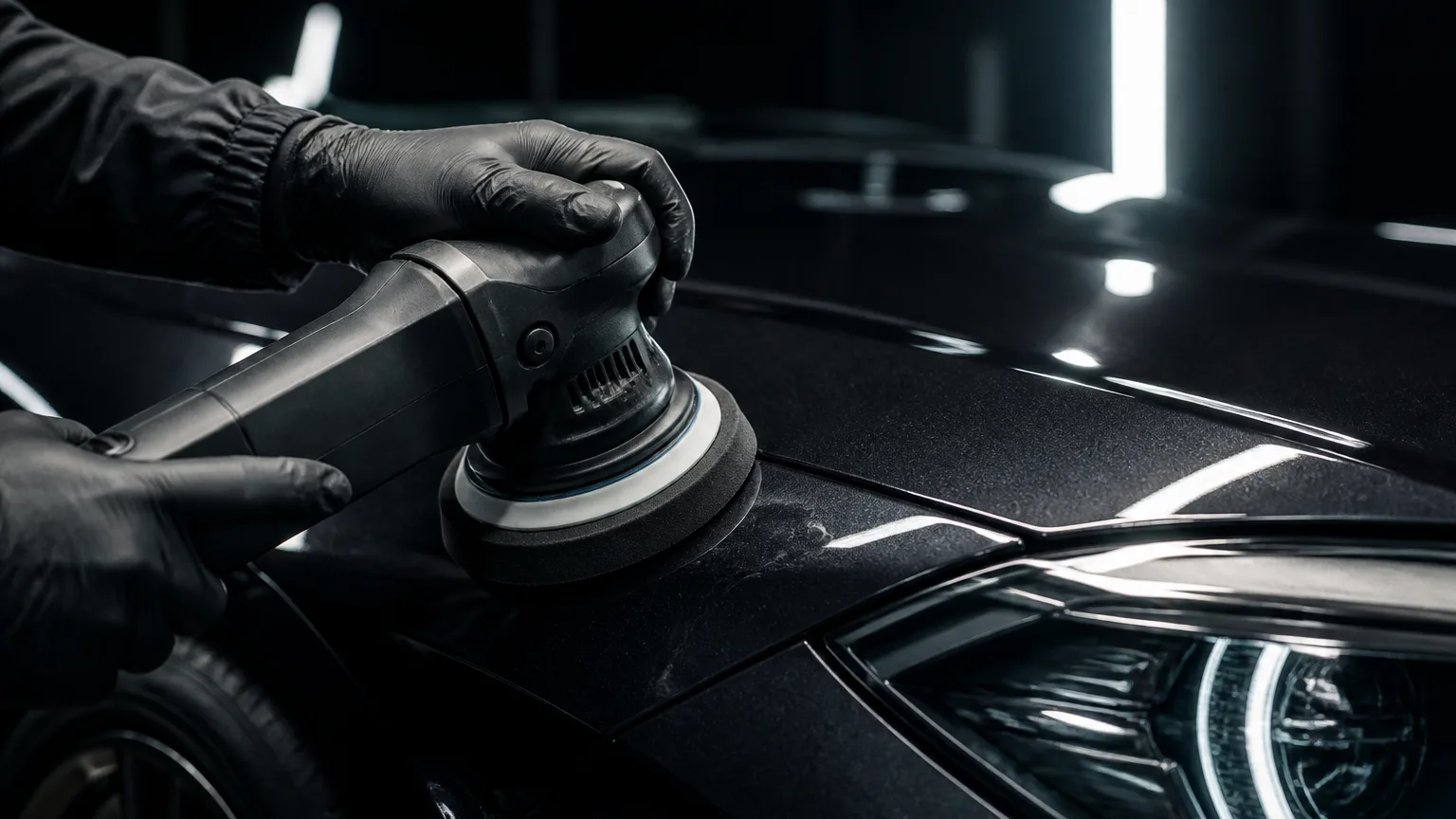
Search for paint correction, car paint correction, or what is paint correction and you get the same cluster of questions: is this just polishing, will it remove every scratch, and do you need it before a coating. This guide answers all three.
This guide covers the concept and the workflow. It is not a pad-speed recipe, not a shop menu, and not a product ranking. There are no ProTaskser test cars and no invented “correction percentage.” Manufacturer and training sources below were checked 2026-08-22. If the label on the bottle or the manual for the machine you own disagrees with a generic sequence, the label wins.
If you need the whole detailing map, use the Complete Car Detailing Guide. If washed paint still feels rough, that is a decontamination decision first — see the Car Paint Decontamination Guide. The Paint Correction & Protection hub is the category landing page, not this article.
In this guide
- What paint correction is — and is not
- Common defects and realistic expectations
- Inspection and preparation
- Why a test spot matters
- High-level correction workflow
- One-step vs multi-stage
- Hand vs machine
- When to stop
- Protection after correction
- DIY vs professional
- Common mistakes
- Maintenance after correction
- FAQ
What paint correction is — and is not
Paint correction is controlled abrasive work on the clear layer of automotive paint. Meguiar’s Greece machine-polishing guide (checked 2026-08-22) states the mechanical rule in one sentence: to completely remove a scratch, the clear coat must be cut back to the lowest level of that scratch. Deeper defects, the same page says, may only come out with a more aggressive rotary process or by repainting. That is the idea. You are leveling peaks in the clear so light reflects more evenly. You are not hiding the valley with oil, wax, or glaze.
The International Detailing Association’s certification study material, published in Auto Laundry News (May 2014, checked 2026-08-22), splits modern paint into two systems. Single-stage paint is pigmented through the top layers — common on older cars. Basecoat-clearcoat is a thin color layer under multiple coats of non-pigmented clear. Most factory vehicles today use the second system. Light waxing and light polishing look similar on both. Deeper work does not. The same study guide notes that oxidation sitting inside clear coat is usually impossible to remove the way you buff dull single-stage color; lightly oxidized clear may only improve temporarily with polishing, waxing, or glazing.
Chemical Guys (12 September 2025, updated 14 September 2025) describe rubbing compound as removing a tiny layer of clear coat to level deeper defects, and polishing compound as the finer step that refines haze and light swirls. That two-part idea is enough for this guide. A dedicated compound-versus-polish comparison is a separate topic, so this page does not repeat it.
Paint correction is not a wash. It is not a glaze that fills scratches until the next shampoo (IDA: glaze improves appearance by temporarily filling). It is not protection. Correction is subtractive. Protection is a later, additive step. And it is not a promise that every mark on a panel can be chased safely.
Common paint defects and realistic expectations
Meguiar’s UK article on the MT320 Dual Action Polisher (checked 2026-08-22) describes the everyday look people mean by car paint correction: cobweb-like marks from poor washing — contaminated sponges and pads — plus general wear. Those wash-induced swirls sit in the upper clear. Light scratches that do not catch a fingernail often live there too. Haze after a heavy cutting step is expected: Chemical Guys say rubbing compound often leaves a hazy finish that polish is meant to refine. IDA’s study guide says the same in training language: compound is aggressive and tends to leave its own minor scratches, which a milder polish is supposed to address.
Oxidation needs the paint-system distinction above. On single-stage paint, dull pigment can sometimes be buffed. On clear coat, IDA says true oxidation in the clear layers is usually not something you simply “compound away,” and light cases may only look better for a while. Water spots and etching are mixed: Chemical Guys put stubborn etched spots on the rubbing-compound side and superficial stains on the polish side. Neither brand is a lab certificate for your panel. Inspect, then test.
Correction will not fill a chip, raise a dent, or replace missing color. If a mark goes through the clear into color, or if Meguiar’s “cut to the bottom of the scratch” rule would take you through the film, the honest next step is touch-up, refinish, or leaving it alone — not another harder pad. This guide will not publish fake before/after scores.
Inspection and preparation before correction
Meguiar’s Greece and Meguiar’s Ultimate Compound directions agree on the first filter: wash, dry, and work on cool, clean paint in the shade. If the surface still feels rough, Meguiar’s UK clay note is practical: clay is an essential prep before swirl or scratch removal; use a dedicated lubricant such as Quik Detailer, not water; if you drop a clay bar, bin it. Chemical iron removers and the rest of bonded contamination belong on the paint decontamination guide. This article will not become a clay how-to.
Inspect after the paint is actually clean. Meguiar’s Greece recommends a halogen lamp to show remaining defects. Sunlight at a low angle does similar work outdoors. You are looking for swirls, haze, isolated scratches, and anything that still catches a fingernail. Factory paint is a thin system. This page will not invent a micron budget. If you own a paint-thickness gauge and know how to use it, measure before aggressive work. If you do not, treat unknown, resprayed, or already-thin panels as a reason to stop earlier, not to push harder.
Keep the cable off the paint (Meguiar’s Greece: over the shoulder). Keep the workspace one you can control. Hot panels flash product dry. Dry product plus a spinning pad is how you grind residue, not how you correct.
Why a test spot matters
Chemical Guys’ compound article opens with a warning that using the wrong product can make things worse. A test spot is how you avoid learning that on a whole hood. Meguiar’s Greece works a section about 50 cm by 50 cm with slow overlapping passes until the product hazes. Meguiar’s MT300 process sheet (Ultimate Compound) uses a 2-by-2-foot section. The numbers are brand procedure, not a universal law. The principle is: small area, least aggressive combination that might work, inspect in the same light you will use later, then decide whether to continue, refine, or stop.
Start milder than your ego wants. A finishing polish on a test square that already looks good is a successful test. Jumping straight to a heavy compound because a forum said “two-step everything” is how you remove clear you did not need to remove. Record what you used. Repeat it only if the square actually improved without new haze you cannot refine.
Caution
Correction removes clear coat. That removal is not reversible. Chemical Guys note that rotary polishers, too much pressure, or working one spot too long can overheat and permanently damage clear. Meguiar’s positions dual-action tools as more forgiving than a traditional rotary — that is manufacturer positioning for those tools, not a physical guarantee that paint cannot be burned. Edges, peaks, and already-thin resprays fail first. If color shows, a fingernail still catches, or the panel heats, stop.
High-level correction workflow
The sequence is boring on purpose:
- Wash and dry on cool paint.
- Decontaminate if the surface is still rough or speckled after a proper wash.
- Inspect under a hard light.
- Test a small area with the least aggressive process that might work.
- Correct only what the test justified, panel by panel.
- Refine if the cutting step left haze (Chemical Guys and IDA both treat polish as the usual follow-up after compound).
- Protect the surface you actually left, not the one you imagined.
IDA’s study guide sketches the same ladder without product names. Paint already in great condition may only need wax, perhaps by orbital. Minor imperfections can use a one-step product or a polish-then-protect pair. More damaged paint is described as a three-step idea: a cutting or compounding buff, a polish to remove the micro-scratching that buff left, then wax or sealant. That is a training taxonomy, not a requirement that every daily driver get three stages.
Meguiar’s Greece: start and stop the machine while the pad is on the paint to avoid sling. Work overlapping horizontal then vertical passes. Wipe residue with a clean microfiber before the next product — Meguiar’s UK is explicit about removing compound before polish and wax, and about not letting product dry. Ultimate Compound directions say the same: do not let it dry; re-apply as needed on stubborn defects.
Do not skip to protection in order to hide a bad cut. IDA is direct: waxing immediately after compounding will hide compounding scratches that reappear the first time the car is washed.
One-step vs multi-stage correction
One-step means one abrasive process that is supposed to cut enough and finish clean enough. Multi-stage means a heavier cutting step, then one or more refining steps. IDA’s study guide treats combination products as handy for minor problems or customers who will not pay for multiple steps, and then says the quiet part: when two jobs share a bottle, each job is somewhat reduced. For best results, use the necessary products one at a time, in order.
3M’s Perfect-It range (official US collision-repair pages, checked 2026-08-22 via 3M.com listings; full-page fetch timed out) is built as a staged finishing system — compound, polish, ultrafine — and also sells a separate 1-step path using a very fine Trizact disc instead of traditional compounding. 3M notes that dark colors may still want an ultrafine follow-up. That is manufacturer system design, not a reason to wet-sand a daily driver in a driveway.
This page will not assign “50% correction” or “100% correction” labels. Those numbers are marketing shorthand, not a measurable film-removal budget. Judge the test square in light. If a single finishing polish already meets the goal, you do not owe the paint a compound pass. For plain-language Compound vs Polish definitions and safe product choice, see the comparison guide.
Hand vs machine correction
Meguiar’s Ultimate Compound directions allow hand or dual-action application. By hand: moderate pressure, overlapping circles, wipe immediately. By DA: overlapping passes, do not let the film dry. Hand work is slower and usually cuts less. That can be a feature on a small isolated mark. It is a poor plan for a whole oxidized hood if you expected machine-level leveling.
Meguiar’s Greece says a dual-action polisher (rotary plus orbital) greatly reduces time versus hand work and that, because of that dual action, “you never have to worry about burning the paint.” Meguiar’s UK MT320 article makes the same contrast with a traditional rotary: easier to use at home, positioned as less likely to damage paint through incorrect rotary technique. Treat those as manufacturer claims for those DA tools versus a high-speed rotary in untrained hands. Chemical Guys still warn that rotary plus excess pressure plus lingering in one spot can overheat clear, and they tell beginners to prefer dual-action for safer correction. Neither brand replaces reading the manual for the machine you bought.
For broader machine categories — rotary, DA, forced-rotation, and light orbitals — see the Car Buffers & Polishers Guide. For dual-action machine choice and technique, see the Dual Action Polisher Guide. This guide stays at the decision: hand for tiny, low-risk work; DA as the usual enthusiast machine class; rotary as higher cut and higher heat risk for people who already know the tool.
How to judge when to stop
Stop when the test-justified goal is met. Stop sooner if the panel gets hot, the pad goes dry, color appears, or a scratch still catches a fingernail after a reasonable cutting step. Meguiar’s Greece already said the quiet exit: some defects only leave with a rotary or with paint. Chasing those with a finishing polish is theater.
Wet sanding is not a beginner step on this page. 3M’s 1-step finishing system uses an extremely fine abrasive disc in a body-shop process. Chemical Guys mention rubbing compound as a first step after wet sanding to remove sanding marks. That assumes sanding already happened under control, with paint-thickness judgment. If you do not have that judgment, do not invent a sanding stage because a video thumbnail said so. Leave deep damage for a painter or a professional detailer who will measure and refuse the job.
Protection after correction
Correction is not a shield. Meguiar’s UK is explicit that polish is not protection and that the revived paint should be sealed with a wax. IDA’s study guide says anytime you use clay, polish, or compound, follow with a protective product such as wax or sealant. Their 2014 durability ranges for wax and sealant are brand-era training numbers, not a warranty; choose a category from current product labels instead.
For what wax, paint sealant, and ceramic spray each are — and why a spray is not automatically a multi-year coating — use Car Wax, Sealant & Ceramic Spray Basics. For ceramic coating vs wax tradeoffs after correction, see Ceramic Coating vs Wax—not a product ranking page. A professionally installed coating is a separate topic. Do not lock in defects on purpose, and do not treat this guide as a coating-install manual.
Apply protection on the surface the last abrasive step actually left: clean residue, cool panel, product that matches the finish (including matte, if that is what you have).
DIY vs professional correction
DIY is reasonable when the paint is known, the defects are light, you can inspect, you will test, and you will stop. Meguiar’s and Chemical Guys both publish enthusiast paths for that case. Professional help is the safer call when the car is a respray of unknown thickness, wrapped or PPF adjacent, already sanded, shows color-through, or you do not have time to work panel by panel in controlled light. This site will not invent shop prices or “hours per vehicle.” Those vary by paint, defect, and the finish standard someone is selling.
A professional who measures, tests, and refuses unsafe correction is doing the job. A cheap “full correction” with no inspection is a rotary story, not a bargain.
Common mistakes
- Correcting dirty, hot, or still-rough paint, then grinding grit into the clear.
- Skipping the test square and running a heavy compound over the whole car because a video used two steps.
- Waxing or sealing immediately after compounding to “see the shine,” which IDA says hides compounding marks until the next wash.
- Treating a glaze or filler wax as paint correction. Fillers wash out. Leveling does not grow back.
- Believing a dual-action polisher cannot damage paint, contrary to heat, dry-buff, and edge reality, even when a brand advertises DA as more forgiving than rotary.
- Chasing chips, dents, or color-through with more cut.
- Wet sanding as a first hobby step.
- Calling the job done without protection, then blaming the polish when wash swirls return.
Maintenance after correction
Correction does not make paint swirl-proof. Meguiar’s UK points at contaminated wash media as a source of cobweb marks in the first place. After you level the clear, the same bad wash puts new scratches in. IDA’s ladder also implies the opposite of a hobby loop: paint that is already in great condition may only need protection, not another cutting stage.
Maintain with a method that keeps grit off the clear. Re-inspect in sun. Re-protect when the layer you chose no longer beads or looks tired — using the category guide linked above, not a second correction as calendar maintenance. If new defects appear, test again. Do not assume last month’s compound is this month’s requirement.
FAQ
What is paint correction?
It is abrasive leveling of the clear (or, on older single-stage paint, the pigmented top layer) so surface defects scatter less light. Meguiar’s: you cut the film down to the bottom of a scratch if you want that scratch gone. Chemical Guys: rubbing compound is the heavier leveling step; polish is the finer refine. It is not wax, and it is not a coating.
Does paint correction remove all scratches?
No. Marks that go through clear into color, chips, and dents are not polish problems. Meguiar’s Greece says deeper defects may need a rotary or a respray. A fingernail catch is a warning, not a challenge coin.
Is paint correction the same as polishing?
Polishing is often one stage inside correction. IDA treats polish as cleaning and shining with milder abrasives, and compound as the heavier correction chemical. A one-step polish on light swirls can be the whole correction. A compound-only cut that you then hide with wax is not a finished correction. For the dedicated polishing workflow, see How to Polish a Car.
How long do correction results last?
The leveling is permanent until new defects are introduced. Wash technique, grit, and parking life put new swirls in. Protection slows that; it does not freeze the car in a show-hall. There is no honest single number of years for “paint correction” as a search query.
Do I need paint correction before a ceramic coating?
Coatings lock in the surface you give them. If that surface is swirled, the coating will not delete the hologram. Whether your car needs a cutting stage before a coating is an inspection question, not a slogan. For install depth, prep standards, and maintenance expectations, see the Ceramic Coating for Cars guide; this page will not become that install manual.
Can I correct paint by hand?
Yes, for small areas, if the product directions allow it. Meguiar’s Ultimate Compound lists a hand method. Machine work is faster and usually more even on large panels. Hand compounding a whole car is how people quit halfway and leave haze.
Is wet sanding part of paint correction?
It can be in body-shop finishing. It is not a routine first step for a beginner with unknown film build. If sanding already happened, Chemical Guys describe compound as a way to remove sanding marks, then polish. Do not add sanding because this FAQ mentioned the word.
Continue in Paint Correction & Protection
This is our main paint correction guide. The category landing is Paint Correction & Protection. Whole-car sequence: Complete Car Detailing Guide. Prep when paint is contaminated: Car Paint Decontamination Guide. Aftercare categories: Car Wax, Sealant & Ceramic Spray Basics.